1971 Bulova Accutron Astronaut Mark 2 Men's Watch - Serviced
DIAL: Astronaut Mark 2-signed silver dial with iconic blue minute and hour hands, and orange seconds hand.
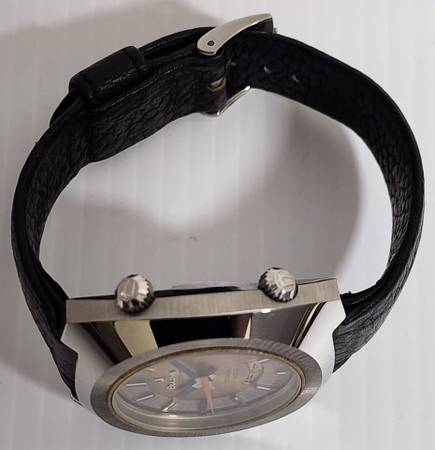
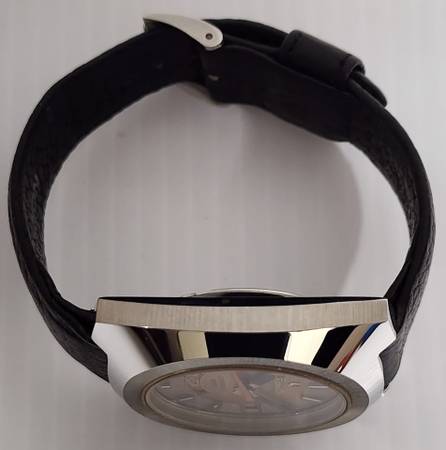
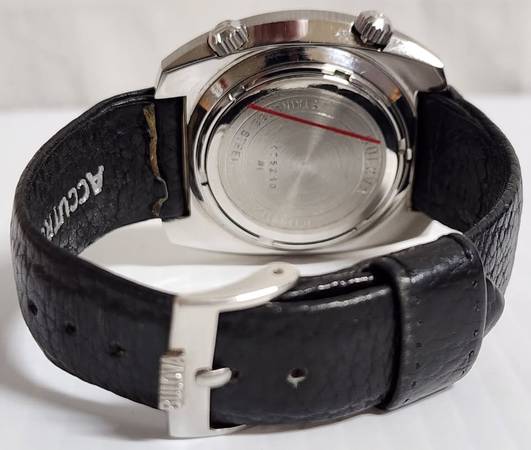
CASE: Stainless-steel case measures 40mm x 42mm, with matching caseback.
CRYSTAL: No marks or blemishes on crystal.
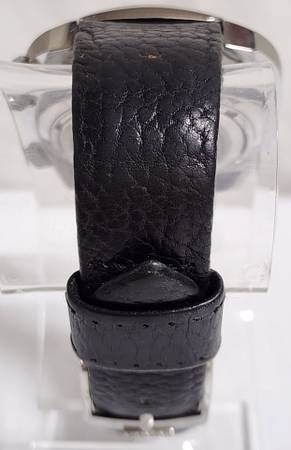
BAND: Black Accutron leather buckle strap.
MOVEMENT: Bulova Accutron tuning fork movement, which vibrates at 360 Hz and uses a button-cell battery. Date setting is non-quickset.
CROWN: Dual crowns..
Bulova’s Accutron Astronaut Mark 2 was a watch with radically new technology. When the first Accutron tuning fork watches were released in 1960, it revolutionized the watchmaking profession. Accutron watches were not quartz watches, which remained a decade away, but rather electric.
The Accutron watch was unlike any other wristwatch at the time, as it did away with the conventional balance and balance spring used by more inferior predecessor electric watches, which oscillated at the same rate as a mechanical watch and could not in principle produce consistently better accuracy than a standard mechanical watch.
The Accutron has no balance or balance spring. Instead, it uses a tuning fork oscillator, driven by a transistor-controlled circuit. The Accutron's tuning fork vibrates at 360 Hz and attached to one limb of the fork is a minute pawl tipped with a nearly invisible ruby jewel.
As the tuning fork vibrates the pawl moves back and forth and this drives an index wheel with 360 miniaturized teeth, invisible to the naked eye. The high frequency meant Accutron movements offered unprecedented reliability, and its reliance on electric power with no requirement for a mainspring made it highly suitable for use in aerospace applications.
Accutron’s electric tuning fork mechanism was seen as revolutionary technology, and it found wide acceptance within astronautics and aeronautics. This notably included in the cockpit of the fastest plane ever made, Lockheed’s A-12 spy plane. The A-12, while highly similar in appearance to the SR-71 Blackbird, was the latter’s immediate predecessor.
Like the Blackbird, the A-12 was made by Lockheed's famous Skunk Works division, which handled classified aircraft development programs for the U.S. military, and U.S. intelligence agencies. When it first flew, it was the most advanced in the world and the U.S. government selected what was then the world's most advanced watch, the Accutron Astronaut.
Though the Accutron had originally been designed for the general market, the construction of the tuning fork mechanism and low inertia of certain critical components gave it good resistance to high G-loads and an ability to withstand high temperatures without becoming inaccurate or otherwise malfunctioning.
This led to the adoption of Accutron movements as cockpit instrument panel timers for manned space flight in the U.S.’s Gemini and Apollo programs – and also made them highly suitable for use in the cockpit of the A-12. The Accutron Astronaut remains a fascinating instance of a revolutionary period in watchmaking.